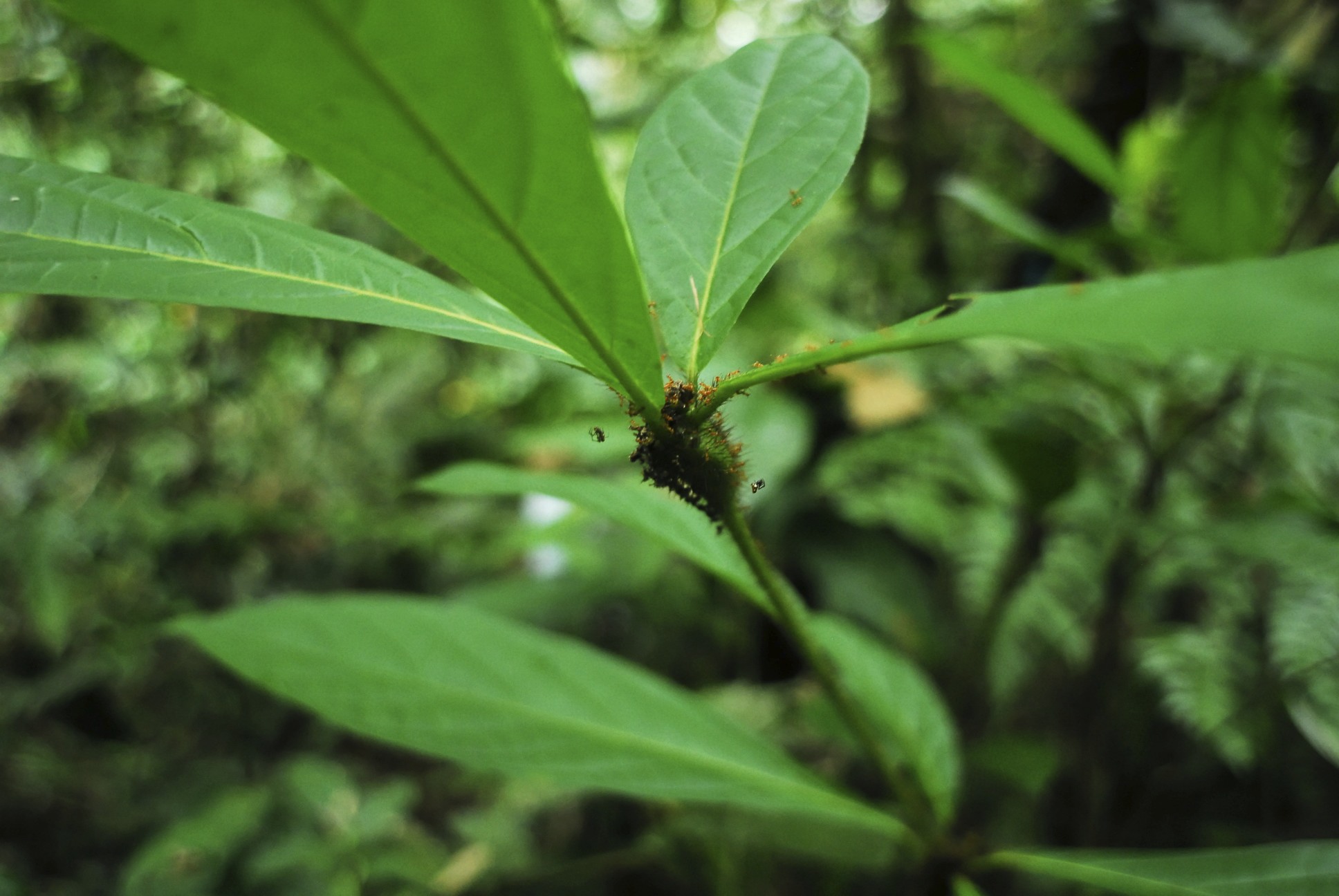
Now is a great time to study mutualisms. Mutualisms are a growing area of research in ecology and evolution, in no small part because molecular techniques are revealing the diversity and importance of many microbial mutualists. There are also more researchers than ever working in the tropics, where for unknown reasons mutualisms seem to be particularly widespread.
The primary goal of research in my lab is to improve the current understanding of the causes and consequences of cooperation between species. We are actively engaged in addressing fundamental questions such as:
[1] Why do mutualisms abound in nature even though natural selection should favour cheaters that take the benefits of mutualism without reciprocating?
[2] Individual organisms are enmeshed in complex webs of interactions with other species and often interact simultaneously with several mutualists. How does coevolution mould species interactions in such large, multispecies networks?
[3] Mutualisms were long viewed as tightly coevolved interactions between single pairs of species, but we now know that this type of mutualism is rare. Most mutualisms involve multiple partner species on one or both sides of the interaction, yet participation is nonetheless restricted to a subset of all the species in an ecological community. What determines species-specificity?
[4] What are the community-level consequences of mutualism? For example, how do mutualisms affect the spread and impact of invasive species?
Ant-plant Mutualisms
In my own research, I address these questions through studies of ant-plant mutualisms in tropical forests. In the tropics, many plant species are myrmecophytic, meaning they house ant colonies in hollow stems, thorns, petioles, or leaf pouches. Often, these plants also produce nutritive rewards for ants in the form of extrafloral nectar or food bodies. In return, the ants defend their host plants against herbivores or other enemies.
Interactions between ants and plants are key components of tropical rainforest communities, since ants and angiosperms dominate the animal and plant biomass, respectively, and ants are the main predators of plant herbivores. At the moment, I am investigating how ant-plant interactions affect other guilds, including not only herbivorous insects, but also pollinators, beneficial fungi, and even spiders that associate with plant-nesting ants. The goal of this work is to elucidate how interactions with third parties affect the mutualism between ants and plants.